Saturday, September 28, 2013

Perfections and Imperfections


As work on my large print continues I begin to reflect on art making and techniques.  The work on the tentatively titled Tipping Point began in ernest in August.  Its size, 24" x 80" and the twelve carved panels required combine to make this my most ambitious woodcut to date.

Trial proofing

Each day in the studio I fight the same reoccurring themes.  First is the idea of scale.  Prints aren't meant to be this large, although some printmakers work at this scale or larger.   I'm attracted to printmaking partly by the process but also by the notion that they are human scale; they can be picked up and held in your hands. Paintings are large, sculptures are large; prints need to be scaled so they can fit onto a press, or fit onto drying racks and into flat files.  Besides, there are so many variables that keeping something this size in registration is next to impossible.

But I find myself seduced by both the challenge and my evolving thoughts on process.  In the world of mokuhanga printmaking we traditionally begin by making a key block.  The key block is most often the black outlines of the image, much like the outlines in a coloring book.  Additional blocks containing the colors of the print are carved and printed based on the position of that key block image.

Digital version of Tipping Point

The image I'm working with has none of the black outlining common to the traditional method as I learned it from my mentor, Keiji Shinohara.   After much experimentation, I've settled on a method of carving a color block, proofing that block and pasting it to the next block; in some ways similar yet more challenging than the outline method.


This is a small section that has been printed lightly with yellow, blue, green and a bit of red.  When I'm done brushing in black ink I'll paste this to another panel and begin carving away everything that isn't black. I'll be left with a block that registers with the previous colors without depending on outlines.

I think a great deal about technique and have struggled to learn best practices. Without regret they seem to be slipping away in this piece.

The scale, combined with the absence of black outlines to disguise minor registration  misalignments seem to free my mind to concentrate on the overlap of shape, color and tool mark.

I'm finally at the point where either lack of technique or overemphasis on technique are standing in the way of the art.


Monday, September 9, 2013

Tool Marks

Full scale mock up of center section of Tipping Point 

I'm currently working on a woodblock with many abstract elements.  Assuming that the abstract parts would be easier to carve is simply not the case.

Tentatively titled Tipping Point, the piece is a composition of watery imagery; coral, sponge, musical notation from sea chanties and fish combined with maps of coast lines and a depiction of an incised bone from 8th century Tikal showing a long sinking canoe containing various deities. This is a picture of the night sky and the canoe is the Milky Way, sinking below the horizon as the night progresses.

In fact this rather large (2' x 7') work in progress is a bit of a bear to carve. My progress in the arcane discipline of woodblock printing has been full of starts, stops and diversions.  It's taken the better part of ten years to get to the point where I'm disciplined enough to see the possibilities beyond creating in a keyblock style where I create an outline and fill in the colors.

Typically in the collages I create the subject of a piece is a combination of drawn, painted and scanned imagery.


In this small piece the original ink drawing is simply glued to the block and the white (non-image) area is carved away.  Larger and more complex pieces like my current work in progress requires more steps but are handled in similar fashion with paper layers pasted to the block and carved.

Without the keyblock as a guide I started with a block containing several main elements and proceeded to use it in the manner of a key block to determine the position and registration of future overlapping elements.


This photo corresponds to the black area in the center area of the top photo.  Currently I'm working on the yellow area that wraps around this dark detail.  The source for this portion of the piece involves map imagery morphing into fish imagery, both positive and negative.


Compared to more realistic areas (those areas requiring more recognizable or specific imagery) this section allows a certain freedom in making tools marks and their characteristic shapes.

Almost complete; with some clean up required and the paper guide still attached.

Thursday, September 5, 2013

Fog of War

Fog of War, woodcut, 4 x 6" ©William Evertson 2013

Keeping with the idea of making small travel pieces this summer, this latest piece, inspired by the horrific gas attacks on civilians in the Syrian Civil War, was completed this past weekend on a trip to Ithaca, NY.

Early, day one, progress on Fog of War

Although the image arose from a current event, the title Fog of War comes from a military phrase that describes the difficulties of decision making in the midst of war.  The phrase came into my vocabulary following the 2003 documentary, The Fog of War: Eleven Lessons from the Life of Robert S. McNamara. The film, while not an exercise in rehabilitation or a revisionist version of the role of this Secretary of Defense during Viet Nam, does shed light on governments seeing what they want to believe.

As I worked on this small piece the debate on the US course of action was reaching fever pitch although the particulars of the attack (at present) are still unknown.  Since Viet Nam the approach to selling the American people on a particular war has become a nuanced and accepted ritual little dependent on actual security needs.

Clean block ready to print

When I posted the work in progress to Facebook one cryptic comment caught my attention; "how would u have helped the jews, gypsies & gays in WW 2 . . .?"  I didn't believe the piece had a particular political stance, although personally I think the idea of our intervention via more violence is ill advised. 

My answer (...and I hate hypotheticals): "Art has very little effect on the great evils that infect the world. Although concerning ww2, the nazi's certainly thought it was valuable to loot and important to suppress."  
Art may be political, it may be unsettling and may be a part of conversations concerning political or social justice issues but by itself my feeling is that when we as artists venture into topical concerns it is as witness rather than forcing change.

Fog of War, Edition of 75 

The piece has been created for the exhibit, A Book About Death, Australia.  The exhibit will open October 18th and run through November 24 at the Tweed River Art Gallery, New South Wales, Australia.


Monday, August 19, 2013

Carving Little Things


The title could have been carving little things over a cup of coffee. I've been traveling a lot over the course of the summer; always leaving the carving of woodcuts behind in my studio in favor of a sketch pad.  But for the last couple of weekends I decided that a weekend might be just the right amount of time to do some small pieces over morning coffee.  

This little piece started as an ink drawing after a portion of Hiroshige's The Mannenbashi Bridge in Fukagawa.


I pasted the drawing to a small (3" x 4") block, threw a knife and a small U gouge into a travel kit and was ready to carve when there were free moments.


I made a proof with a scrap of (dry) Kizuki Hanga this morning and was quite pleased.  I've always admired how Hiroshige places us in the composition by often incorporating foreground elements.  The turtle, a long established symbol of longevity stares longingly at the leaves, river and Mount Fuji.  

According to notes on this image, on the 15th day of the Eighth Month during the observation of Hojoe, birds, fish and turtles are released from captivity during the festival. 

While carving this one I started imagining the turtle on a journey after his captivity as a subject for a future piece.  Perhaps this small piece can be part of it as a cartouche. 


The previous week-end I completed a small piece that is to become part of Maria Arango-Diener's Puzzle Print.  Eighty-five artists are contributing blocks loosely based on the theme of a "Fantastic Garden"  Maria cut the puzzle blanks and mailed them out.


None of us know what the neighboring pieces will look like until Maria assembles and prints the piece. Link to more about the Puzzle Print on Maria's blog.


Occasionally I carve even smaller.  These are part of my series of hand carved signature seals.  I have about 60 of these.  I often include one as part of signing a finished piece.  Each oval image impression is about an inch and a half.   From left to right - Ganesha, Man with Umbrella, Diego, Frieda and the Footprints of the Buddha.

Friday, August 9, 2013

New Tool


Carving resumes on the Fish Song woodblock.  It was set aside as I finished the Photobooth Kabuki pieces which were exhibited in New Hampshire and the Chelsea Art Walk last month.

The size of this piece, which will require seven blocks, each approx. 2' x7', also means lots of acreage to clear around each image element.

 
Time for a power carver; at least for working on pieces of this scale.  I decided on an Auto Mach from among the several brands on the market and so far I'm in love with it.

The images I'm working on here have areas of intricate detail which still has to be done by hand with a knife; either one of my hangi to or the disposable #16 X-Acto.  In the few days I've used the Auto Mach, it has been clear out the trenches between image elements.

 Cartoon for Fish Song - ©William Evertson 2013

The photo above is the cartoon or my guide for the imagery that overlaps to make up Fish Song.  The piece was originally part of The Billboard Art Project and this digital version along with several others were exhibited in Atlanta during the Fall of 2012.   


The piece itself combines elements both abstract and literal, referencing sea charts, climate change, coast lines, musical notation of sea chanties and obviously, fish.

Sunday, July 28, 2013

Busy Being Busy

Sharing work with friends during the recent Chelsea Art Walk. (Photo by AnnMarie Tornabene)

July has turned into a very busy month.  I remembered a Times article from a year ago about our self imposed busyness and thought back a few month to when I had July pegged as downtime; perhaps a time to begin some new works in the studio.  It's turned into exhibition month and that's meant busy work.  Busy framing works, writing press releases, busy packing art, busy traveling and busy trying to PR it all.  All the things that go with exhibiting and that's part of the artist's job... exhibiting.  I'm part grumpy hermit artist and so I'm starting to long for a few free mornings in front of blank paper and slightly restless for beginning new works.  


My entire four print series of Photobooth Kabuki woodcuts was complete in time to exhibit during the Chelsea Art Walk last Thursday.  I was able to display them in a project space in Ayn Choi's new venture, Gallery 304 at 526 W 26th st. in Chelsea.

The picture on the left shows a thumbnail of the woodcuts paired with the photo booth self portrait that is the first layer in each print.  The first layer is a solarplate etching followed by between 5 and 8 color blocks.

The series is traditional mokuhanga, with water based inks and printed with a baren on kizuki hanga, an extraordinary 100% kozo handmade paper, printed in editions of 12.

The bottom piece will be included in the 2013 North American Print Biennial this fall and I'll go into more detail on that closer to the opening at 808 Gallery, Boston University on October 27th.


Posing with my Kabuki series at the Chelsea Art Walk 

The last exhibit I need to get ready for is not strictly an art exhibition, instead Susan Shulman and I will be showing our collaborative comic, Kalicorp Art Mysteries at the Boston Comic Con on August 3rd and 4th.  Thanks to our small but loyal followers who supported our recent Kickstarter we've completed 7 issues to date, all of which we'll be displaying in Artist Alley.


For more about Kalicorp Art Mysteries you can visit our dedicated Art Mysteries blog.

Sunday, July 21, 2013

Chelsea Art Walk


This July has been hotter than most and I've been particularly fortunate to have exhibition opportunities heat up.  Just back from installing art in New Hampshire last week, I'm working on preparing pieces that I'll be showing during the Chelsea Art Walk on July 25th. This is the fourth annual Art Walk that features extended hours for galleries plus open studios throughout the Chelsea area.

I have a modest project space in Ayn S Choi's recently opened Gallery 304 at 526 W 26th street where I'll be showing recent woodblock prints.  I'll be at the gallery from 5pm until 8pm. Works by Eugene J Martin are also on display and I'm honored to be sharing wall space.

Two of the prints relate to an ongoing collaborative effort that combines Exquisite Corpse writing with images to provide alternative endings to the unfinished novel Mount Analogue by Rene Daumal.  René Daumal was a French spiritual para-surrealist writer and poet, most known for this posthumously published novel that used mountain climbing as a metaphor for spiritual quests.  The novel ends in mid-sentence and for several years a small group of artists have contributed to the Analogue Narratives blog with their thoughts and images.  The two moku hanga woodcuts I have on display relate to my recent contributions to this project.

All four parts of the Photobooth Kabuki series that I've blogged about over the last couple of months is finally editioned.  All four will be on display along with the black key blocks that begin each print.  The Photobooth Kabuki pieces were inspired by purikura photo booth machines that come with edit­ing screens so you can dec­o­rate and cus­tomize your photo after it is taken.  This ability to bring Photoshop abilities to a photo booth to make your eyes larger, nose smaller, perfect skin, more anime and add captions led me to redo my own photo booth picture by adding bits and pieces from Utagawa Kuniyoshi's warriors and kabuki actors to my features.

Photobooth Kabuki 1 - ©William Evertson 2013

Saturday, July 13, 2013

Wrap Up from Gordon-Nash


LAYERS is installed at the Nash Gallery and on view until the end of July.  I would like to thank curator and  Head Librarian Cathy Nolan Vincevic, her staff and board of directors for their help and encouragement.

In a one person show you can see a comprehensive body of work and where an artist has been.   I believe that an artist can also use the opportunity to see where to go next.

In this exhibit I selected several works from each year of my last decade's production.  Ten years ago I was immersed  in the possibilities of combining scanned images in the (then) relatively new artists tool Photoshop.


Stamp Collector and Meltdown on the end wall combine a variety of scanned material; letters, photographs, stamps and drawings.  Completed in 2003 and 2004 these digital pigment prints reflect an interest in the layering of a personal iconography to construct visual narratives.


Working with ink on paper is a discipline that developed during that period, almost as a counter-point to the computer driven works.
I participated in an artist residency in Thailand. I became aware that the Asian artists who were not so enamored of contemporary Western trends in art came from a tradition of rigorous attention to art 'basics'.  I realized probably for the first time the gulf between my New York centric view of conceptual, pop and minimalism, the pressure for gallery representation, and the longer view of an artist's career that concerned my Asian friends.

There seemed to me to be a certain respect for incorporating past tradition into the contemporary, while the Western arc involved new 'movements' usurping art world interest.

I was inspired (or perhaps a bit chagrined) during certain times when interpretors weren't around and we fell into drawing for communications.  My friends had used brushes for writing since childhood and their drawing seemed to flow effortlessly between writing and image.  Mine left a bit to be desired; a skill that had gone fallow.


After I returned to the States I began to work with a renewed interest into cross-cultural referencing.  The exploration of archetype and myths that find expression in disparate cultures became an influence that I continue to explore.


During this time period I also became aware that a Japanese printmaker I admired had begun to teach at nearby Wesleyan University.  The moku hanga woodcuts that are part of this exhibit are a result of several years of study in this technique which complimented the ideas I was working with digitally.


In the library proper, the mixed media game boxes from my Ox and O's series found a home in display cases.

The Nash Gallery where the most of my work was installed also housed the original collection of the library, donated by Judge Nash, along the entire length of one wall.  A very concise and interesting history of the library can be found at the libraries "History Link".


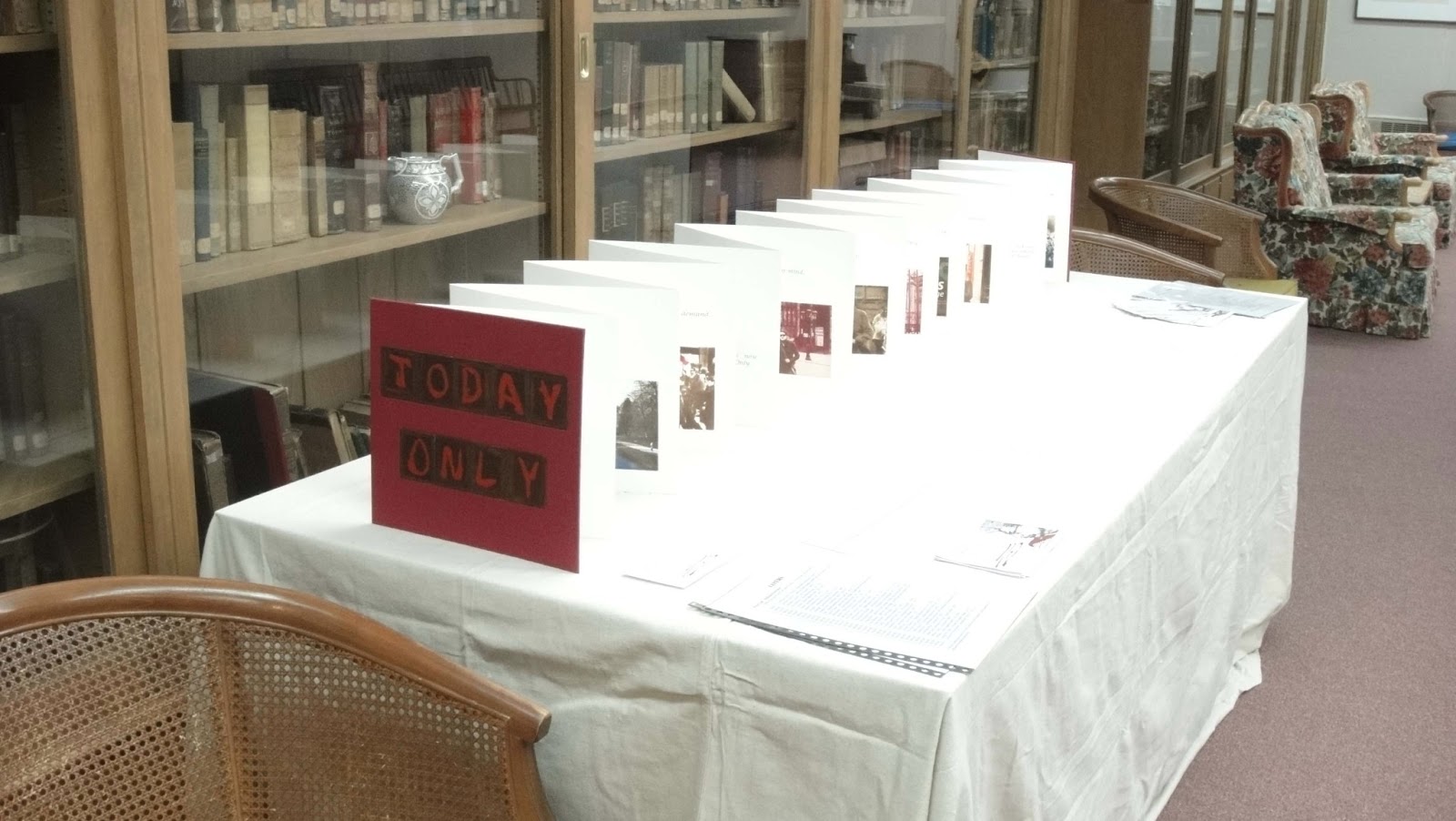
A portion of the several thousand volume collection forms a backdrop for my accordion book, Today Only, which is part travelogue and part documentation of performances in Belgium and France in collaboration with artists Susan Shulman and Ria Vanden Eynde.

LAYERS is on display in the Nash Gallery in the Gordon-Nash Library through July. 


Sunday, July 7, 2013

A Novel Idea


My custom book jacket created for the Gordon-Nash Library's 
soon to be donated copy of Rene Daumal's Mount Analogue.


While preparing for the Nash Gallery Exhibit at the Gordon-Nash Library I inquired if they had a copy of Rene Daumal's novel Mount Analogue.  The current head librarian Cathy Nolan Vincevic informed me that no, unfortunately sometime in the past it may have been weeded out of their collection.   Two of my latest prints relate to the French surrealist authors unfinished work and I was hoping to have a copy of the book to display next to those pieces.

I decided that it might be fitting to donate a copy to the library.  Unfortunately, the hardcover version is out of print and not wanting to donate a paperback I started looking for used hard bound copies.  They can be expensive!  At least for 'perfect' copies.  I decided that perhaps a copy of Damaul's book sans jacket would do nicely since I've spent the last several years with a group of artists working on an Exquisite Corpse ending (complete with illustrations) to this book.

My custom book jacket is based on one of my ink sketches Hotei with Blue Squirrel.

You can find the collaborative efforts of the several artists I work with on the Mount Analogue project at this LINK.

Link to my exhibition information at the Nash Gallery. Opens Wed. July 10 and runs to July 30th.

Thursday, July 4, 2013

Preparations


Measuring twice and cutting once.  At least that was the caption I used when I shared this photo on FB; then the slasher comments began.  I paused for a photo op in the middle of making frames for several of my latest woodblock prints that will be exhibited in New Hampshire beginning next week, little realizing that I have a future as a horror movie villain.

While it would be great if I was far enough up the ladder that I didn't have to worry about constructing frames, pr and the hundreds of details that go into exhibiting art, that's not the cards yet.  So, I'll make use of my mad woodworking skills to cut slabs of cherry, run it over the molder head and make some  simple but workable frames. Nothing elaborate, just an arched top with rounded corners; an elegant, soft profile.

Molding head cutting the arched top.
In an oddly romantic way I enjoy making the frames for my own pieces.  It reflects years of hard learning to master a craft and craft is something that is not only disappearing from our lives but the way it is valued in the arts has undergone profound changes.

The idea of apprentices aiding an artist in the studio has given way to the primacy of the artist's vision and at the higher levels of the art market, fabrication by specialists is the norm.

The result is often flawless meticulous works of art.
(Think Jeff Koons 'Gazing Balls' - John Yau on confusing perfection for genius)

In the area of woodblock printing, especially moku hanga that I work in, it was once the norm for an artist to turn over his design for a master carver to make blocks from and in turn to be printed by a master printer on paper made by other masters of that craft. (This type of collaboration is also prevalent in other types of printmaking as artists are often aided by master printers)

As an artist who began making art during the the late 1960's during rise of Conceptual Art, I've had an affinity for the primacy of the artist's idea. Yet, my earlier, teenage years were spent in my fathers autobody shop where hands on labor intensive work shaped experiences of direct working with materials.

Finished frames drying in the shop

The current work I'm exhibiting this summer at the Gordon-Nash library is a reflection of both my early pre-artistic hands on learning of 'craft' skill and a fascination with the sosaku-hanga movement of early 20th century printmaking. Sosaku hanga being based on principles of self-drawn, self carved and self printed.  

My printmaking mentor, Keiji Shinohara works in that vein after rigorous apprenticeships in the three foundations.  I believe the art lies somewhere in finding a balance of skills while maintaining an eye to personal and authentic visual narrative.    

My exhibit, LAYERS opens July 10th in the Nash Gallery at the Gordon-Nash Library.

Link to exhibit